
adult learner, Advice, Education, First generation, Online, self care

Hey, We Got That PMA!

Written by Lux Marquez, Educators United & Pride@NU Club Member

College is chaos. The world is chaos. And if you’re reading this, you’re probably trying to survive both with your brain, your heart, and your dignity intact. So let’s talk about something radical, something loud, something that punches through the noise like a power chord at a basement show: Positive Mental Attitude—PMA, baby.

Now, before you roll your eyes and mutter “toxic positivity,” hear me out. PMA isn’t about pretending everything’s fine when it’s not. It’s about choosing to fight with love, with fire, and with the unshakable belief that you matter—even when the system says you don’t.
A collage featuring the letters 'PMA' prominently in the center, surrounded by various playful graphics including hearts, a megaphone, a record, a vintage camera, headphones, and a cat, all set against a muted green background.


Bad Brains said it best: “Don’t care what they may say, we got that attitude!” That’s not just a lyric—it’s a battle cry. PMA is punk. It’s resistance. It’s showing up to class when your rent’s overdue, your government’s a mess, and your identity’s under attack. It’s writing that paper like it’s a manifesto. It’s organizing, surviving, and thriving in a world that wasn’t built for you. And Bikini Kill? “I’ve got the love that’s strong and not weak!” That’s the kind of love PMA demands. Love for yourself, your community, your weirdness, your rage. PMA doesn’t mean you’re never angry—it means your anger is rooted in hope, not despair.

In a world where marginalized students are told to shrink, PMA says: Take up space. Be loud. Be brilliant. Be unapologetically you. Whether you’re the only queer kid in your class, the first in your family to go to college, or just trying to stay afloat in a sea of deadlines and doomscrolling—PMA is your armor and your amplifier. So next time you’re staring down the barrel of that 10-page paper, a protest, or just another day of being alive in 2025, remember: You’ve got that attitude. And that attitude? It’s punk as hell.


Advice, community engagement, First generation, self care

Freedom in Letting Go

By Annyce Torres, President of Mind + Body Wellness Student Org

There is an oft repeated saying that “anything you have to control, controls you.”

Woman in front of railing.
Annyce Torres
President of Mind + Body Wellness Student Org

What are we holding on to that is limiting our freedom that we might not be aware of? As humans, we have the ability to weigh out our options and take inventory of what is best for us. We are usually able to understand the danger of holding onto things that no longer serve us and our highest goals. Unfortunately, so many of the hardships that we experience in life are those that we create for ourselves.

As a first-generation college student, I’ve had to take a hard look at the behaviors and beliefs that I’ve held onto over the years. I’ve had to realize that the behaviors that I used to engage in no longer serve me. They were adopted as tools used to survive in situations that I am no longer in. The beliefs that I used to have such as self-doubt and other limiting beliefs will not serve me as I move forward in my attempt to learn enough to serve others. The people that I used to associate with are not necessarily understanding of the direction that I am taking my life.

Woman in front of blue sky.
Annyce Torres
President of Mind + Body Wellness Student Org

Whether we are clinging to being “right,” anger and resentment, self-pity and self-doubt, or people that are not in line with our highest goals, we run the risk of placing those attachments ahead of our own well-being. We must take advantage of our ability to think critically. And as we engage in this self-examination it is best to remember that the trap itself is not the problem. It’s the choices that we make – and continue to make – that determine whether a trap is a trap after all. It is our willingness to let go that determines our freedom to move forward and live our best life-with the degree we are earning.

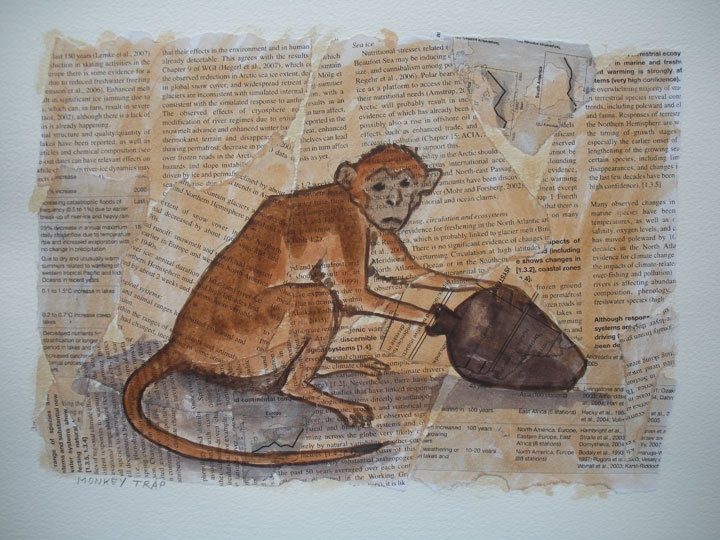
I’ll leave you with this story I once read about how hunters trapped monkeys in Africa and Asia:

Monkey in a trap drawing
Monkey Trap – image reference

It’s said that in order to catch the monkey, hunters would first drill a hole in a location just large enough for the monkey’s hand to go through and place a nut or fruit in it. Seeing the food, the money would reach through to grab it, but his closed fist would be too large to fit back through the hole, trapping it in place. Even as the monkey would see the hunter closing in on him, he still would not let go of the food in order to escape.

In the end, the monkey gives up his very freedom, in exchange for a handful of food. The monkey is blinded by its attachment to what is in front of him. Let this serve as a reminder for us to forward beyond our own attachments that may be holding us back and trapping us in toxic situations.

Continue the conversation! Take some time for yourself and connect with other students!

Join Annyce on the fourth Thursday of every month from 5-6pm PDT for the Mind + Body Wellness monthly meetings! You can join the meetings via this Zoom Link!

Open to all students! Find community with others interested in all things wellness! ✨🌻🙌

And don’t forget to follow @mindbodywellnessnu on Instagram for updates and mental health resources!

self care

Don’t Forget to Breathe: Learning the Art of Energy Management

by Marissa Mosley, NU Scholar  

Click on our playlist to listen to soothing music as you explore this blog post!

In honor of Public Health Week and April being Stress Awareness Month, we chose to feature a blog written by one of our amazing scholars—Marissa Mosley! Keep reading to learn more about how to manage your energy to promote mindfulness and avoid burnout. Enjoy!

P.S. If you find this topic interesting, check out our Public Health Week Virtual Panel! The panel recording can be found here (passcode: JL+yuu7O). You’ll hear from student leaders across multiple programs as they discuss how culture plays a role in overall health. This year’s Public Health Week focuses on cultural health, community, mental health, food, & nutrition. 🌍

Hiking through the beautiful landscape of Hana, Hawaii, one of my favorite ways to replenish my mental/emotional/spiritual energy. 

We frequently hear of the importance of time management, but very rarely do we discuss the significance of energy management. The perfect plan does little to help us produce results if we lack the energy to follow through. Learning to manage your energy well can lead to greater productivity and a more balanced life. 

It is beneficial to know to what extent certain tasks drain you. In addition to requiring different amounts of energy, various tasks also require different types of energy. To maximize our ability to follow through with our plans, it is important that we understand the primary types of energy that we utilize daily.

If you are struggling to find the energy to take steps toward your goals, you may be depleted in one or more of the following types of energy.

4 Energy Types

  1. Physical: The energy that you use to do anything physical. 
  1. Mental: The energy that it takes to plan, create, contribute to conversations, etc. 
  1. Emotional: The energy that you use to process your emotions and relate to others. 
  1. Spiritual: For those who consider themselves to be spiritual, this is the energy that you use and receive for spiritual purposes beyond the physical.  

4 Tips for Managing Your Energy Well  

  1. Perform an Energy Audit
  • Take notice of your daily rhythms (the times of the day when you generally feel drained, and times of the day when you have the most energy). 
  • Pay attention to which tasks energize you and which ones drain you.
  • Figure out if your current routines are conducive to maximized energy. 

  1. Practically Prioritize
  • Keeping your energy audit in mind, create a priority list for the day. 

  1. Prepare 
  •  Each week, on a high-energy day, take time to prepare for your busy days. 

  1. Don’t Forget to Breathe 
  • Prioritize rest. 

We can take steps toward establishing positive routines and finding balance. As you navigate this chaotic season of life, please remember to take care of yourself. Do not neglect the filling of your energy tanks.

In managing your energy well, you will be better equipped to be a help to both yourself, to those who you love, and to the causes that are important to you.

Let’s keep the mindfulness going! If you use of any of these tips and post about it on your socials, be sure to tag @nationaluniversity and use our hashtags #NUfam and #NUCSEA so we can repost!

To keep up with the Center for Student Engagement and Activities, make sure to check out our Linktr.ee and monthly flyer which can be found on the “What’s NU this Month?” tab at the top of our blog!